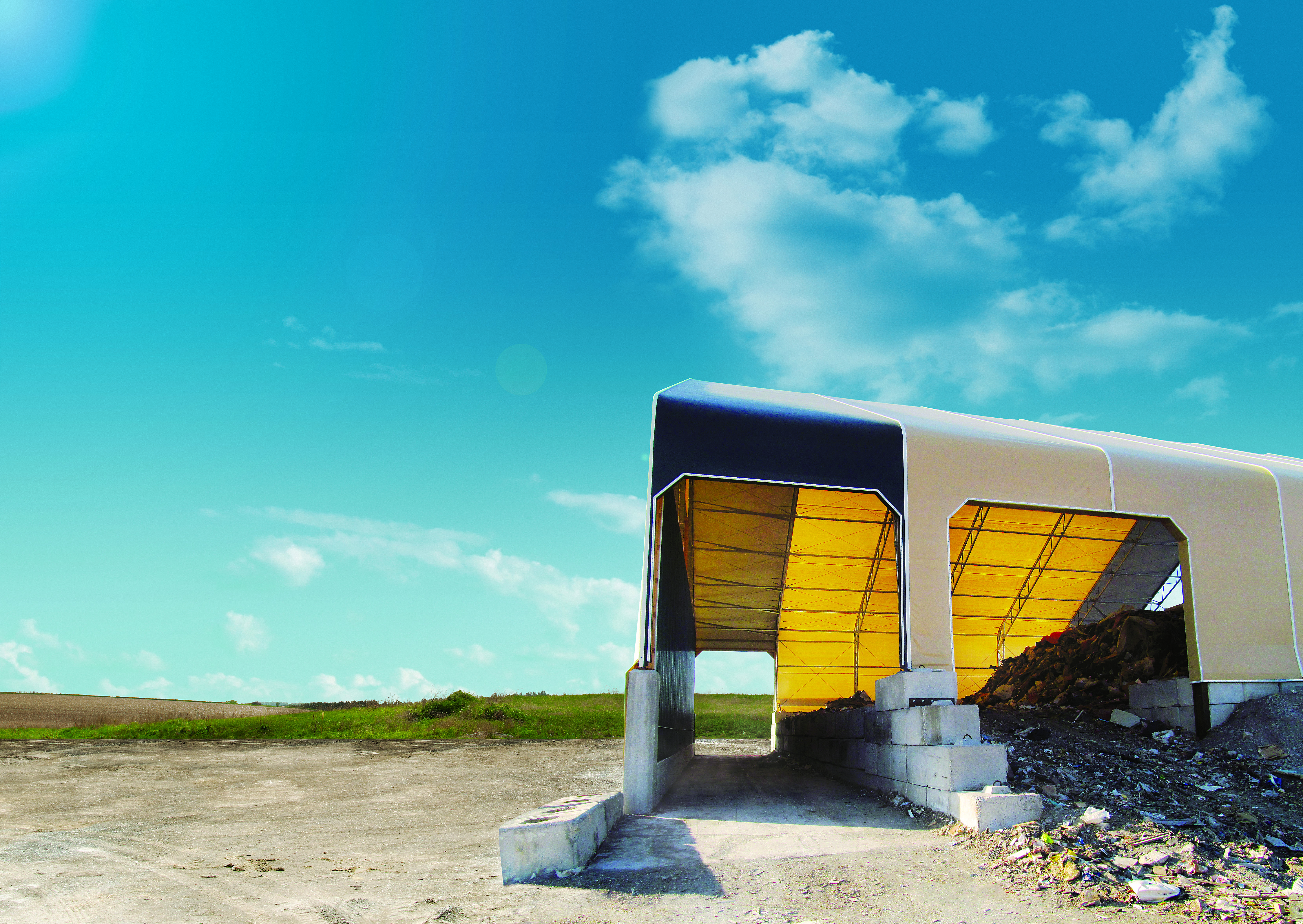
Waste transfer stations are essential infrastructure but designing them correctly is a complex challenge. According to the U.S. Environmental Protection Agency’s Waste Transfer Stations: A Manual for Decision-Making, success depends on balancing operational efficiency, environmental protection, and community impact.
Facilities must handle heavy traffic, large volumes of waste, and strict environmental controls, all while remaining cost-effective and adaptable over time.
What’s changing today is how these facilities are being built.
Engineered fabric structures for waste transfer stations are emerging as a smarter way to meet EPA guidance while improving long-term performance.
The EPA emphasizes that transfer stations must be designed to:
These are not optional features; they are fundamental requirements for long-term success. The challenge is delivering all of this without excessive cost, long construction timelines, or operational compromises.
Fabric buildings are often recognized for speed and cost, but the EPA’s priorities demand something deeper: predictable, reliable structural performance under real-world conditions.
This is where Calhoun Super Structure fundamentally separates itself.
Through its proprietary engineering process, Calhoun models the true behavior of fabric under environmental loads using advanced 3D nonlinear finite element analysis. This approach simulates how wind, snow, and seismic forces interact with both the fabric membrane and steel frame, producing a structure tailored to its exact site conditions.
Unlike simplified or linear assumptions, this method captures the nonlinear behavior of tensioned fabric systems, where shape, stress, and load continuously interact.
The EPA stresses the importance of unobstructed tipping floors and smooth traffic flow.
Calhoun’s wide-span fabric structures eliminate internal columns, enabling:
At the same time, each structure is engineered with accurate load paths and foundation forces, ensuring the building performs exactly as intended under heavy, repetitive use.
Transfer stations operate in demanding environments, wind exposure, snow loads, and constant vibration.
Calhoun addresses this through site-specific 3D nonlinear analysis, which:
This level of engineering ensures the structure doesn’t just meet code; it is optimized for its exact location.
The EPA highlights the importance of minimizing disruption during construction and operation.
Fabric structures offer:
Calhoun structures enhance this further with engineered efficiency, reducing both material use and construction time while maintaining structural integrity.
EPA guidance strongly supports controlling:
Fabric structures enable fully enclosed transfer stations, making it easier to integrate:
Because they are engineered for durability and corrosion resistance, these buildings perform reliably even in harsh waste-handling environments.
Cost is one of the EPA’s key decision factors, especially for municipalities evaluating whether a transfer station is viable.
Calhoun fabric structures improve the financial equation through:
In fact, advanced 3D analysis can significantly improve foundation efficiency by accurately modeling structural interaction with the ground, leading to more economical designs without sacrificing safety.
The EPA emphasizes planning for future waste system evolution.
Calhoun structures are uniquely suited for this:
Even as a permanent solution, a Calhoun structure retains the flexibility of a temporary one, offering a level of adaptability traditional construction simply cannot match.
What truly defines Calhoun’s approach is the depth of its engineering.
Each project includes:
This ensures that every structure is not just built but engineered to perform over decades.
The EPA manual doesn’t prescribe building materials, but it does define outcomes:
Calhoun Super Structure’s engineered fabric buildings align directly with these goals, delivering facilities that are:
Waste transfer station design is no longer just about meeting minimum requirements; it’s about building smarter infrastructure that performs under pressure.
By combining EPA-aligned design principles with advanced nonlinear engineering, engineered fabric structures for waste transfer stations provide a solution that is not only compliant, but future-ready.