In the manufacturing industry, efficient storage isn’t just about organization—it’s about productivity, profitability, and resilience. As Emily Newton highlighted in her piece “How to Overcome Common Manufacturing Storage Challenges,” many facilities struggle with space limitations, poor inventory visibility, and inflexible infrastructure. These main points have only become more critical as global supply chains continue to evolve and demand remains unpredictable.
One increasingly popular solution helping manufacturers address these challenges is the utilization of fabric structures—a modern, cost-effective, and highly adaptable alternative to traditional warehouse construction. By combining the flexibility of fabric buildings with smarter inventory practices, manufacturers can gain the space, visibility, and efficiency they need to stay competitive.
Let’s explore how fabric structures can directly address the four most common manufacturing storage challenges Newton identified.
1. When Inventory Outgrows Available Space
As manufacturing demand rises, many facilities find themselves outgrowing their available storage faster than they can expand. Traditional building projects can take months or years and cost hundreds of dollars per square foot—an unrealistic option for many companies needing immediate space.
Fabric structures provide an ideal solution. They can be constructed in a fraction of the time, at a significantly lower cost than steel or concrete buildings. These tensioned membrane facilities can also be easily expanded, relocated, or reconfigured as operations grow.
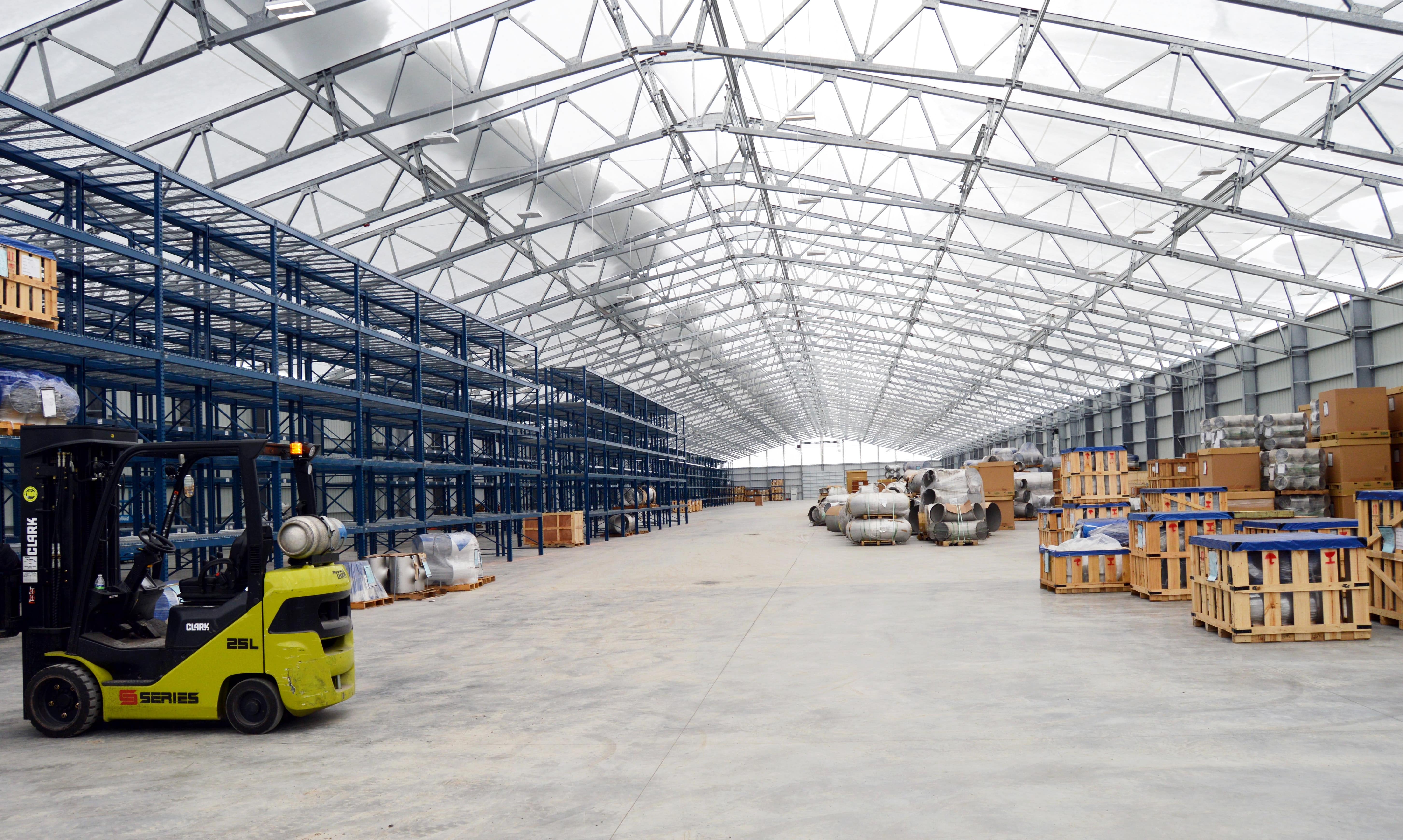
With their open-span design—meaning no interior support columns—fabric buildings maximize usable space, making it easier to install high-density shelving, vertical racking systems, and automated storage units. This flexibility allows manufacturers to grow vertically and horizontally without compromising efficiency or disrupting production.
2. Limited Inventory Visibility
Newton noted that lack of visibility into inventory levels can lead to costly inefficiencies and mismanagement—issues that cost global industries over a trillion dollars annually. Technology like RFID tags, IoT sensors, and AI-driven inventory management systems are vital tools to enhance visibility.
Fabric structures support these technologies perfectly. Their clear-span interiors make it easy to integrate automated storage and retrieval systems (AS/RS) or smart racking setups. Plus, fabric structures feature translucent membranes that allow up to 80% of natural sunlight to illuminate the space. This soft, even lighting improves visibility for workers while reducing energy consumption, leading to a safer, more sustainable, and more productive warehouse environment.
3. Inefficient Picking and Order Processing
Manufacturers lose valuable time and money when order fulfillment is slow or disorganized. Newton emphasized that reducing redundant processes and implementing automation are key to boosting efficiency.
Fabric structures complement these strategies by offering customizable layouts that streamline workflow. Without interior columns, these facilities allow for smooth traffic flow for conveyors, AGVs (autonomous guided vehicles), and forklifts—improving material handling speed and accuracy.
Additionally, the natural lighting in fabric buildings contributes to a brighter, more comfortable work environment. Research shows that natural light not only reduces energy costs but also improves worker morale and productivity—small changes that can yield major gains in order processing efficiency.
4. Fluctuations in Demand
Demand fluctuations are among the most difficult challenges manufacturers face. As Newton pointed out, unpredictable shifts—like those seen during the COVID-19 pandemic—can expose the limits of static storage solutions.
Fabric structures are built for flexibility. They can be deployed quickly during peak seasons, resized to meet changing storage needs, or even relocated to another site. This adaptability makes them perfect for temporary or overflow storage during periods of high demand.
Moreover, manufacturers can use fabric structures as their business scales, adding capacity as predictions shift. This approach prevents both overbuilding and storage shortages, helping companies maintain stability as they grow.
As Newton concluded, improving manufacturing storage is essential for greater efficiency and resilience. While technologies like automation and IoT are transforming how inventory is managed, fabric structures are transforming where it’s managed.
Their advantages—speed of construction, cost savings, energy efficiency, and flexibility—make them an indispensable part of the modern industrial landscape. By integrating fabric structures with advanced inventory management systems, manufacturers can overcome common storage challenges while preparing for the uncertainties of tomorrow.
Manufacturing storage doesn’t have to be a bottleneck. With the combination of smart data systems and flexible, high-performance fabric structures, companies can create storage environments that are efficient, scalable, and resilient.
Fabric structures aren’t just shelters—they’re strategic tools for growth.