When assessing the cost of fabric structures compared to traditional options like wood, steel, or concrete, the choices can be overwhelming. What’s critical to know are the long-term and short-term cost benefits and the indirect and direct cost benefits. In most cases, fabric free-span buildings cost significantly less than traditional wood, steel or concrete buildings, and the cost savings can be enjoyed on both upfront building costs and maintenance costs over time. Keep reading to learn how fabric buildings can save you money.
A few factors influence fabric building prices, including materials, labor, maintenance, electricity, and ventilation.
Costs of materials for building projects can vary greatly depending on size and current market prices. While steel frames typically have higher material costs than wood, wood buildings typically must account for a significant portion of waste overages and sheathing. Add in long-term weather damage, pests, mold, warping or rot, and you’ve spent more than a steel frame structure.
Compared to fabric free-span building costs, which incorporate a certain amount of steel material in its frame, you still save greatly on the fabric roof. At its minimum, a pre-engineered steel building can cost an average of $34 per square foot and increase from there. Fabric structure costs can range between $20 to $30 per square foot.
Construction time is a necessity in any building project. What counts the most, however, is the hours spent on site prep, foundations, erecting the framework, roofing and finishing. Unlike the labor-intensive construction of wood, steel or concrete buildings, fabric buildings are typically quicker to install because of fewer materials and the simplicity of installing fabric.
Steel frames can be erected anywhere from a few hours to a few days, max, depending on the size and amount of steel frame. The fabric is then either pulled across the building in one seamless bag cover or installed in individual panels. This, also, can take anywhere from a few hours to a few days. On average, fabric-covered buildings require .02 to .03 man-hours per square foot installed versus .04 to .07 man-hours per square foot installed for steel sheeting which could save you hundreds of man-hours on a 20,000 square foot facility or larger.
Most wood, steel or concrete buildings require annual maintenance such as painting or staining in addition to re-roofing, re-shingling or re-tarring. More money is spent on materials and labor time especially if you live somewhere with cold or wet seasons.
With a fabric free-span building, costs are saved on fabric structure annual maintenance. Since fabric buildings do not have screws or nails along the roofline, areas for moisture entry are mitigated, thereby reducing leaks, rust or corrosion. Unlike full steel buildings, the steel frames in fabric buildings are typically hot-dip galvanized, further protecting against corrosion. Additionally, the fabric itself is immune to rust and corrosion and does not break down from UV rays, further keeping your building free from maintenance.
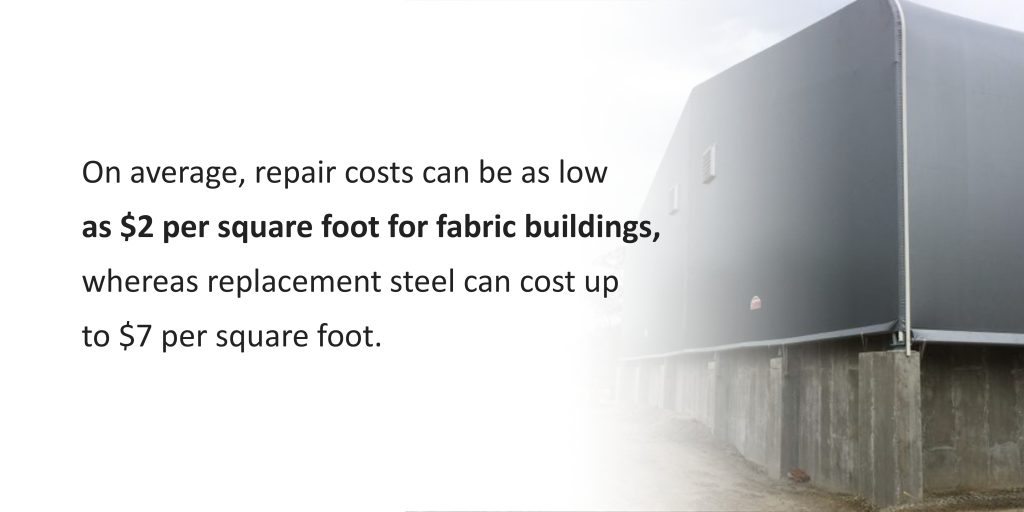
Should a fabric repair or replacement arise, fixes can be done with a patch kit or the removal of an individual fabric panel. On average, repair costs be as low as $2 per square foot for fabric buildings, whereas replacement steel can cost up to $7 per square foot.
Fabric buildings typically offer anywhere from 16% to 19% translucency which means the interior receives an abundance of natural daylight. This is one critical differentiator from traditional wood, steel or concrete buildings. Without the natural light in a conventional building, windows, skylights and artificial lighting is required. Over time, you could end up spending thousands on long-term lighting.
Furthermore, tension fabric structures typically require little lighting for nighttime use since the underside of the fabric roof reflects and disperses any artificial lighting that you do have inside. Thus, you also save on the number of artificial lights you need to purchase. Both short-term and long-term, fabric structures save you thousands of dollars on lighting alone. Solar panels can be added to the fabric building design and installed on top of the fabric roof to further offset energy costs.
Traditional buildings’ heating and cooling costs are significantly higher since the heating and cooling units need to work harder. Since fabric buildings are naturally non-conductive, the interior of a fabric building remains cooler on hot days and warmer on cool days. The fabric does not retain heat from the sun thus maintaining interior temperatures.
To improve ventilation in fabric free-span buildings, side vents, end wall vents, roof vents, make-up air systems and radiant tubes can all be added to the structure. With Calhoun’s high-top design and versatile profile design, high roof peaks further offer a large volume of air space and circulation. In essence, ventilation and heating and cooling systems do not need to compete with the many sources of airflow as in traditional wood, steel or concrete buildings.
At Calhoun Super Structure, we offer tension fabric buildings for a competitive price of just an average of $6 to $30 per square foot. For a standard CC Series kit that does not come with end walls, the price may be as low as $6 per square foot, while large-scale operations that include ends, foundation requirements, doors and additional accessories will be closer to $15 to $20 per square foot.
For cover-all building costs, you can expect a similar price range. Across the United States, many coverall buildings will need to be replaced or upgraded, and our team at Calhoun Super Structure can handle these repairs and recovers. Factor in the various influences on your fabric building cost to calculate a potential price range. This will help you create a budget that works for you.
For many industries, fabric clearspan structures provide a cost-efficient and time-saving alternative to traditional structures. By significantly cutting your construction time down, you can move into your fabric building quicker and get to work. Also, lower maintenance, lighting, and ventilation costs provide long-term cost savings to put extra money back in your pocket over time. Contact us at Calhoun for more information or request a quote from us today.
To download our helpful cost comparison infographic, click here.