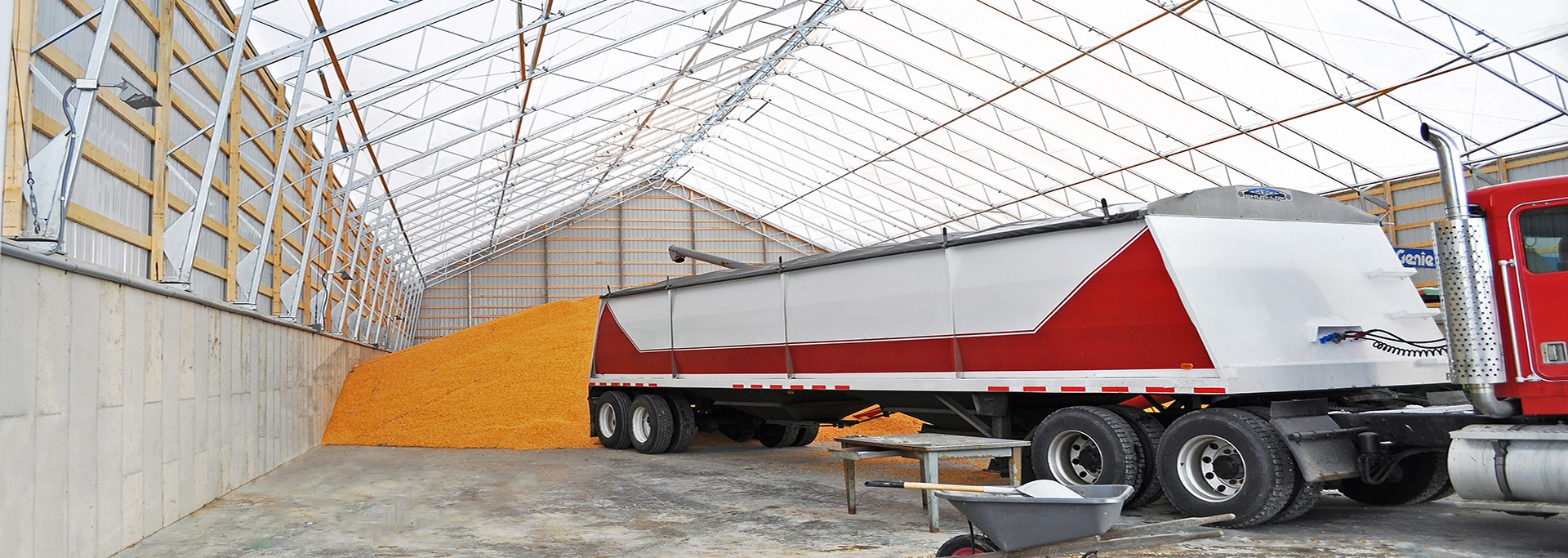
Bulk storage structure or commodity storage fabric buildings can be a significant investment, so it is critical to keep in mind the long-term maintenance costs and value of stored materials.
The smallest amounts of moisture can wreak havoc on bulk storage structure materials or other sensitive items, thus, a well-ventilated fabric building is imperative to safely storing grains, salts, or fertilizers. Such materials spoil more quickly once they’ve been exposed to moisture. According to Tri States Grain Conditioning Inc, millions of dollars in crops are wasted every year due to damage brought on by uncontrolled moisture levels.
Alternatively, if your bulk storage structure stores materials or items other than crops, moisture is also known to cause clumping and accelerate the growth of mold and mildew. This can permanently damage expensive assets or property, and pose a significant threat to human and livestock health. Mold, mildew, and dampness have been shown to have a number of negative effects on humans and animals, including:
Keep the fresh air moving and mitigate moisture with these fabric building essentials:
All of Calhoun’s fabric bulk storage structure are thermally-conductive meaning that on a very hot or humid day, the interior of the fabric building remains cool. With thermally-conductive fabric, the heat transfer occurs at a lower rate within the fabric material than it would in traditional buildings. Thus, interiors are less susceptible to becoming humid, in turn, mitigating risk of dampness or mold.
We offer numerous add-ons, upgrades, and extensions during the design and engineering processes. Our customers have the option to select from a number of ventilation systems if their application requires increased airflow. Ventilation may be needed for a number of reasons: employee and livestock health, productivity, and caustic environments all play a part in the selection process.
A handful of the options we frequently find ourselves recommending to clients include:
A common contributor to increased wear and tear on fabric is when fabric companies apply a linear analysis when engineering their fabric structure, causing the fabric to bow and take a shape in indirect proportion to the weight of environmental loads. This results in unnecessary repairs and replacements, sooner, meaning there is greater chance of the fabric being less airtight and thus, allowing moisture to get inside.
Many fabric structure companies fail to take an in-depth look into the mechanics of fabric using a linear analysis. This means that when the fabric is under pressure from the weight of snow or other environmental elements, the fabric moves in exact proportion to the amount of load applied. If the load doubles, the fabric moves twice as far.
Calhoun is unique in that we have developed specialized analysis which models the shape of fabric under load. By accurately determining various environmental loads that are applied to your steel structure, we use a non-linear analysis. This results in a longer-lasting, more airtight fabric building.
Just before you contact us, check out this helpful infographic that gives you an overview of all the things you should consider!