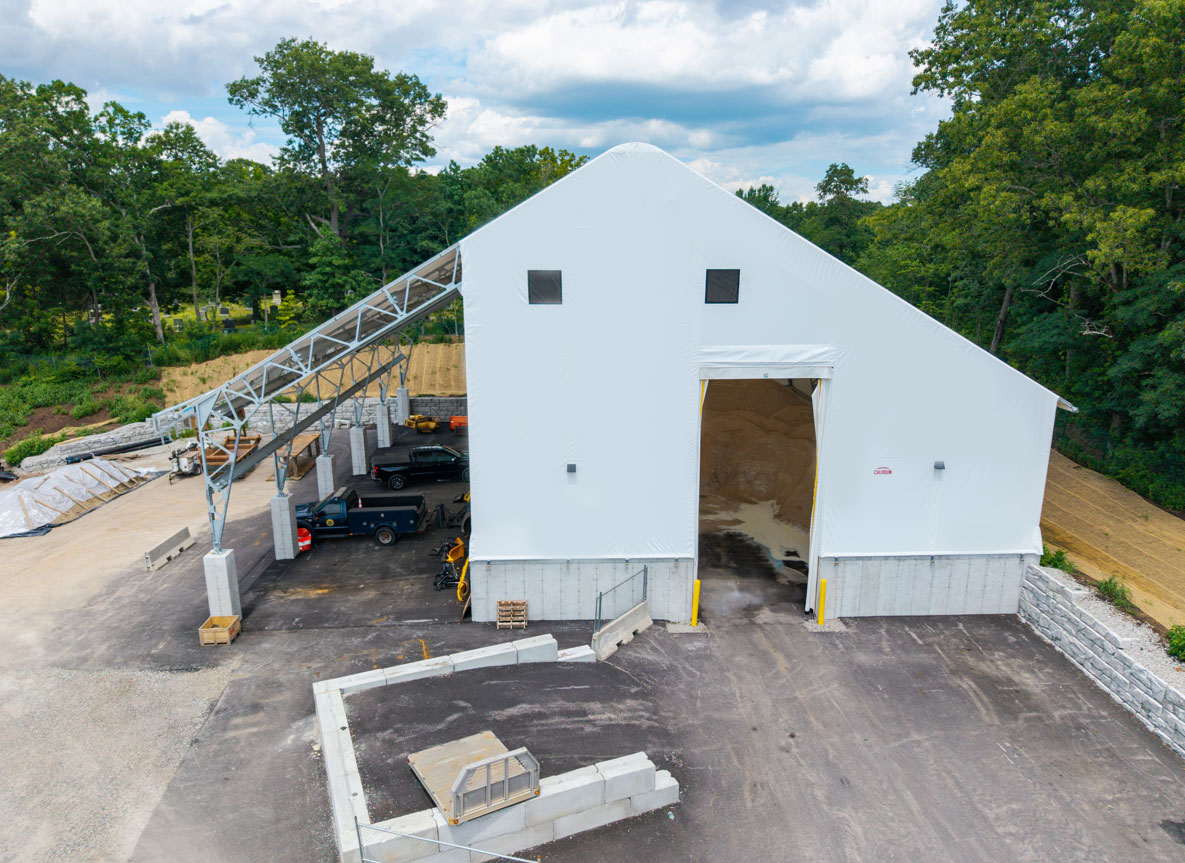
The best road salt storage building is one engineered for the site, sized around the municipality’s current and future material volumes, and designed to limit exposure to moisture while supporting safe, efficient loading and unloading. For many public works operations, a fabric-covered structure is a strong choice because its non-corrosive cladding, bright clear-span interior and flexible foundation options are well suited to bulk salt and sand storage.
When winter weather arrives, a municipality’s salt supply becomes critical infrastructure. Crews need to load trucks quickly, equipment needs room to manoeuvre, and stored material must remain protected and ready for use.
That makes the storage building more than a place to keep a pile of salt. It is part of the municipality’s winter-response system—and choosing the wrong building can create operational bottlenecks, premature deterioration and avoidable long-term costs.
So, what should public works departments look for in a road salt storage building?
Salt is highly aggressive to many conventional building materials, particularly when moisture is present. Over time, a poorly planned storage environment can contribute to corrosion, damage and increased maintenance requirements.
The building also has to withstand demanding daily use. Loaders need sufficient clearance to move and turn. Trucks need practical access. Material must be contained, separated when necessary and protected from precipitation. The structure itself must also be designed for local snow, wind, seismic and other site conditions.
A practical salt storage solution therefore has to address three priorities at once:
There is no universal building design that works for every public works yard. The right choice depends on storage volume, site constraints, equipment, loading methods, local building requirements and plans for future growth.
However, engineered fabric structures for salt storage offer several advantages that make them particularly well suited to municipal salt and sand storage.
Unlike exposed metal cladding, an HDPE fabric cover does not rust. This gives municipalities an important advantage in a salt-rich environment, where corrosion is a constant concern.
The building’s entire material system still matters. Frame protection, connection details, ventilation, foundations and maintenance requirements should all be considered during design. A quality salt storage structure is not defined by its cover alone; it is the result of an integrated, site-specific solution.
Interior columns can restrict loader movement, reduce usable pile capacity and complicate day-to-day operations. A clear-span fabric structure creates an open interior that allows equipment operators to use more of the available floor area.
For public works teams, that can mean:
The building should be planned around actual equipment dimensions and movement—not simply around the desired tonnage. Door height, door width, peak clearance, turning space and pile-wall configuration can all influence how efficiently the building functions.
Translucent fabric allows natural daylight to enter the building during daytime operations. The brighter interior can improve visibility around stockpiles, equipment and personnel while reducing dependence on electric lighting during daylight hours.
This is a practical operational benefit, especially during busy winter events when crews may be moving continuously through the facility.
Salt storage buildings can be designed for installation on a range of foundation systems, depending on the building series, site and operational needs. These may include concrete walls, precast blocks or other engineered foundation solutions.
Concrete or block walls can serve two purposes: supporting the building and helping contain bulk material. The appropriate wall height should be determined by expected pile loads, loader activity, storage capacity and the engineered building design.
A salt shed should never be selected from dimensions alone. Snow loads, wind exposure, seismic conditions, building use, topography and nearby structures can all affect the design.
Calhoun structures undergo a site-specific engineering review and use 3D nonlinear finite element analysis to assess how the building system responds to applicable loads. Stamped drawings are provided by a professional engineer licensed in the project region, as required.
This matters because a municipal building is expected to perform when conditions are at their worst—not only on an average day.
Start with the amount of material that must be stored, but do not stop there. A building sized only to the theoretical volume of the salt pile may be frustrating or unsafe to operate.
Planning should account for:
A municipality expecting growth should consider whether a modest increase in building length or width today could prevent an expensive expansion or replacement later.
Should Salt and Sand Be Stored in the Same Building?
They can be, provided the building and containment layout are designed for it. Separate bays or dividing walls can help keep materials organized and reduce mixing. The design must also allow operators to access each material without creating traffic conflicts or striking walls, frames or stored material.
This is where early input from the people who operate the loaders and trucks is valuable. Engineering determines what the structure must withstand; operators help identify how the space needs to work every day.
Before requesting a quote, ask potential suppliers:
The lowest initial price does not always represent the lowest total cost. A building that restricts operations, requires frequent repairs or cannot accommodate future needs can become expensive long after construction is complete.
The best road salt storage building is not simply the biggest structure that fits the site. It is the one that supports how the public works team receives, stores and moves material—while standing up to the local environment and the corrosive nature of its contents.
An engineered fabric structure can combine open interior space, natural daylight, adaptable foundations and non-corrosive cladding in one practical solution. When the building is designed around the site and the operation, it can help crews work efficiently through the winter seasons ahead.
Do not wait until limited capacity, deteriorating cladding or inefficient loading slows down your winter operations. Calhoun can help your team evaluate storage volume, equipment clearances, foundation options and site-specific loading requirements to develop a structure suited to the way your public works department operates.